Guide · GitHub → Lark · Verified November 1, 2026
GitHub to Lark webhook guide
Short answer: One GitHub endpoint verifies each delivery, a destination filter keeps the events in this guide, and every match is delivered to Lark with its own retry schedule and delivery log.
A comment that mentions the bot is the approval gate for an agent workflow, and the group needs the same signal. This pairing posts the comment into the Lark group with the issue link, so the conversation stays next to the work while the event stays on GitHub.
At a glance
1. Configure the GitHub webhook
- In the repository, open Settings → Webhooks → Add webhook and paste the endpoint's ingestion URL.
- Set Content type to application/json and paste the same signing secret the endpoint uses.
- Choose “Let me select individual events” and enable Issues, Issue comments, Pull requests, Pushes, Releases, and Workflow runs as needed.
- Open or label an issue to send the first delivery, then check the delivery log.
HMAC-SHA256 over the raw request body, compared in constant time. No timestamp header, so there is no clock-window check.
2. Filter to the events that matter
Filters run per destination before rendering, so a non-matching event is stored with no delivery and no agent call. The rules below are the difference between a useful pairing and a noisy one.
Filter: comments that mention the bot
{
  "allow": [
    { "field": "event.type", "op": "equals", "value": "issue_comment.created" },
    { "field": "event.subject.body", "op": "contains", "value": "@agent" }
  ],
  "senders": {
    "allow": { "associations": ["OWNER", "MEMBER", "COLLABORATOR"] }
  }
}
3. Configure the Lark destination
A Hooks Lark destination posts a text message to a group's custom bot webhook on open.larksuite.com. The URL is a project secret, and when the bot's signature check is on, Hooks adds the timestamp and HMAC-SHA256 signature the bot requires.
Destination: Lark custom bot
{
  "webhookUrl": "{{secret.LARK_WEBHOOK_URL}}",
  "text": "{{event.actor.login}}: {{event.subject.body | truncate:200}}\n{{event.subject.url}}",
  "signature": { "secret": "{{secret.LARK_SIGN_SECRET}}" }
}
Secrets enter configs only as {{secret.NAME}} references; literal credentials are rejected. Full Lark target guide
4. Verify the delivery and its retries
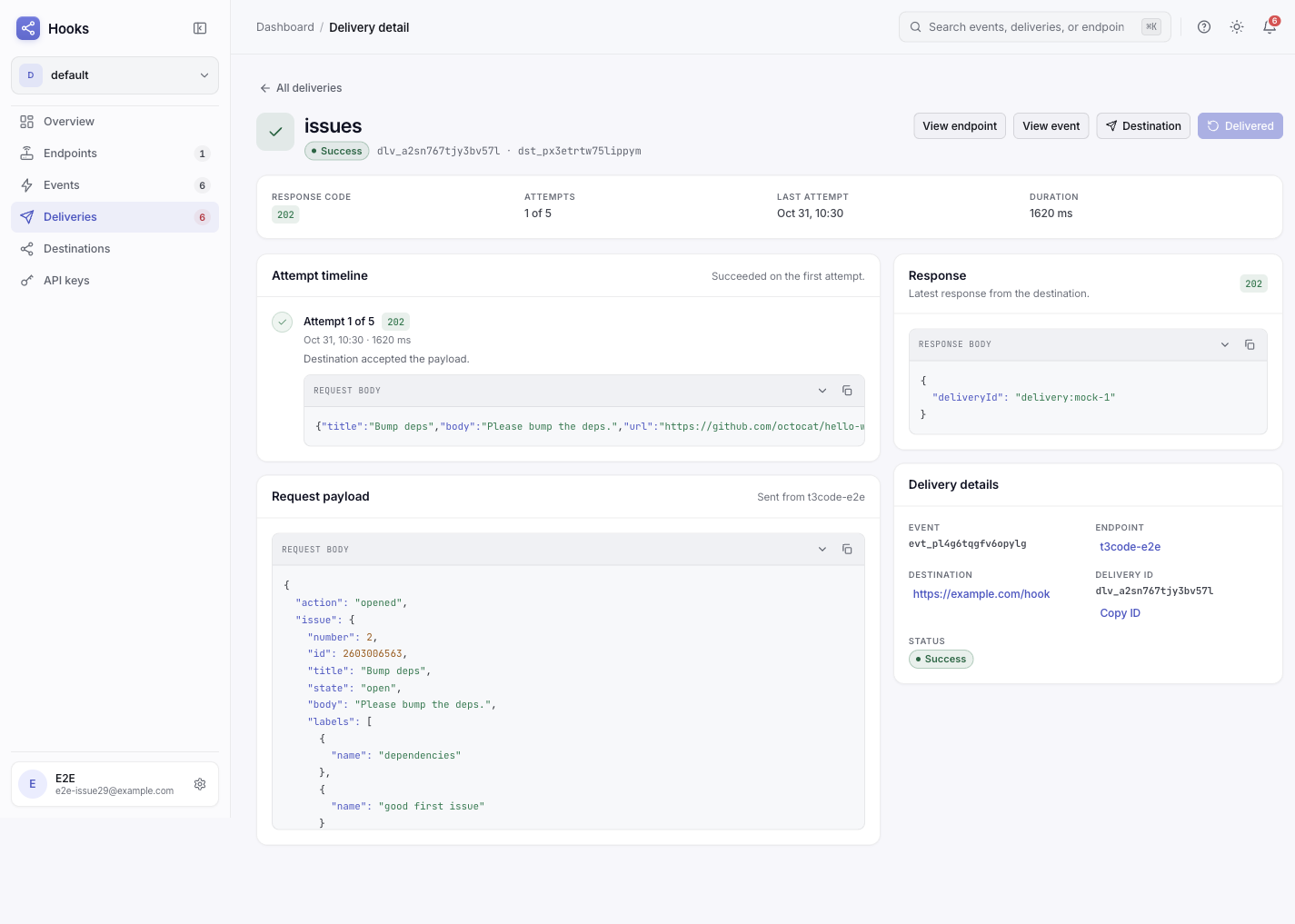
Send one real event from the source, then open Deliveries. A 2xx from the target means accepted, not finished. 408, 425, 429 and 5xx retry with backoff honoring Retry-After; other 4xx fail permanently with a named code. The rendered request is stored per attempt, so a bad field path is visible without re-sending.
The pitfall this pairing hits
A signed bot rejects messages outside its clock window. Lark checks the request timestamp against its own clock with a one-hour tolerance. A worker with a drifting clock produces signatures Lark considers stale — the reply is still HTTP 200 with a non-zero business code, so the failure surfaces in the delivery log rather than as a transport error.
Frequently asked questions
Do I need one endpoint per source or one per destination?
One endpoint per source. Each destination under that endpoint carries its own filter, template, retry schedule, and delivery log, so the same event can feed several targets without duplicate ingress URLs.
What happens while the target is down?
Retryable failures back off and retry within the destination's window; permanent 4xx failures stop immediately. Either way, the original event stays stored, so after fixing the target you replay the event instead of asking the source to send it again.
A signed bot rejects messages outside its clock window
Lark checks the request timestamp against its own clock with a one-hour tolerance. A worker with a drifting clock produces signatures Lark considers stale — the reply is still HTTP 200 with a non-zero business code, so the failure surfaces in the delivery log rather than as a transport error.